In today’s digital landscape, ensuring the security of user authentications is paramount. One innovative approach to bolster security is through the use of geolocation. By integrating geolocation data into authentication processes, services like MagicEndpoint can significantly enhance security measures. This blog will explore the various methods of geolocation, including IP and GPS, and highlight why mobile phone GPS with a Bluetooth link to a computer is a superior approach.
Understanding Geolocation Methods
Geolocation refers to the process of determining the physical location of a device. There are several methods to achieve this, with IP geolocation and GPS being the most common.
- IP Geolocation: This method involves mapping an IP address to a physical location. IP geolocation services use databases and algorithms to approximate the location based on the IP address. While this method is widely used due to its simplicity and ease of implementation, it has notable limitations. The accuracy of IP geolocation can vary significantly, often providing only a rough estimate of the user’s location
- GPS (Global Positioning System): GPS relies on a network of satellites to provide precise, real-time location data. Devices equipped with GPS receivers can determine their exact geographic coordinates by triangulating signals from multiple satellites. This method offers high accuracy and is commonly used in navigation and location-based services
The Vulnerability of IP Geolocation
Despite its widespread use, IP geolocation has inherent vulnerabilities that can compromise security. One of the most significant issues is the ease with which IP geolocation can be spoofed using a VPN (Virtual Private Network). VPNs mask the user’s real IP address by routing their internet traffic through a remote server, effectively hiding their true location. This makes it relatively simple for malicious actors to bypass IP-based location checks, rendering this method less reliable for security-critical applications.
The Superiority of Mobile Phone GPS with Bluetooth
In contrast, using mobile phone GPS data linked to a computer (which typically do not have GPS chips) via Bluetooth offers a more secure and accurate approach to geolocation. Here’s why:
- High Accuracy: GPS provides precise location data, often accurate to within a few meters when outdoors. This level of accuracy is crucial for ensuring that the user is in the expected location during authentication. Mobile phones also can use other sources to improve accuracy such as Wi-Fi, and cellular tower triangulation when GPS signals are weak when in big buildings or underground. The end result is consolidated, accurate, precise, location data but for short I will call it GPS location.
- Real-Time Verification: Mobile phones are equipped with GPS receivers that can provide real-time location updates. By linking this data to a computer via Bluetooth, MagicEndpoint can verify the user’s location during the authentication process
- Reduced Spoofing Risk: Unlike IP geolocation, GPS data is much harder to spoof. While it is theoretically possible to fake GPS signals, doing so requires sophisticated equipment and technical expertise, making it a less viable option for most attackers
- Bluetooth Link: The Bluetooth connection between the mobile phone and the computer adds an extra layer of security. This link ensures that the GPS data is transmitted securely and can be used to verify the proximity of the user to the device being authenticated. (With network connected authenticators there is no assurance that the location of the phone is the same as the location of the computer.)
Implementing Geofencing with MagicEndpoint
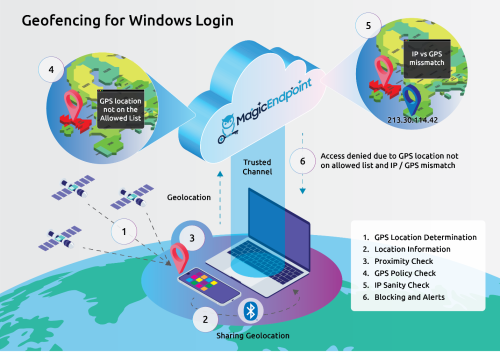
MagicEndpoint leverages the strengths of mobile phone GPS and Bluetooth along with IP based geolocation to enhance authentication security with geofencing. Here’s how:
- GPS Location Determination: The MagicEndpoint authenticator obtains geolocation data from the mobile phone which it calculates from GPS satellites, cell phone triangulation, etc.
- Location Information: The location data is transmitted via Bluetooth to the computer, providing real-time location information.
- Proximity Check: The Bluetooth connection ensures that the mobile phone is in close proximity to the computer, further validating the user’s presence.
- GPS Policy Check: MagicEndpoint verifies that the GPS coordinates of the mobile phone match an allowed location (e.g. country).
- IP Sanity Check: MagicEndpoint checks the mobile phone-based GPS location against the general location as determined by IP address.
- Blocking and Alerts: Any significant deviation or a mismatch between mobile location, IP location, and allowed locations can trigger additional security measures, such as failing the authentication or alerting the administrator to potential suspicious activity.
Conclusion
Incorporating geolocation into authentication processes can significantly enhance security, and MagicEndpoint is well-positioned to leverage this technology. While IP geolocation offers a basic level of location verification, its susceptibility to spoofing via VPNs makes it less reliable for security-critical applications. In contrast, mobile phone GPS data, transmitted securely via Bluetooth, provides a highly accurate and difficult-to-spoof method for verifying user location. By implementing this approach, combined with IP Geolocation, MagicEndpoint can offer robust, location-based authentication with geofencing that enhances security and provides peace of mind for users.